

The Perfect Storm Facing Customer Experience Leaders
In boardrooms across the world, similar conversations are unfolding. Customer experience costs are rising. Hiring is getting harder. Automation is not delivering the savings that were promised. At the same time, regulatory reforms and labor law changes are reshaping the economics of support operations.
For years, customer support felt like a simple choice. You either outsourced to a BPO or built an in-house team. Both approaches were created for a stable labor market and both scaled the same way by adding more people. The assumption was clear: costs would rise slowly and predictably, and growth would simply require more seats. That assumption no longer holds.
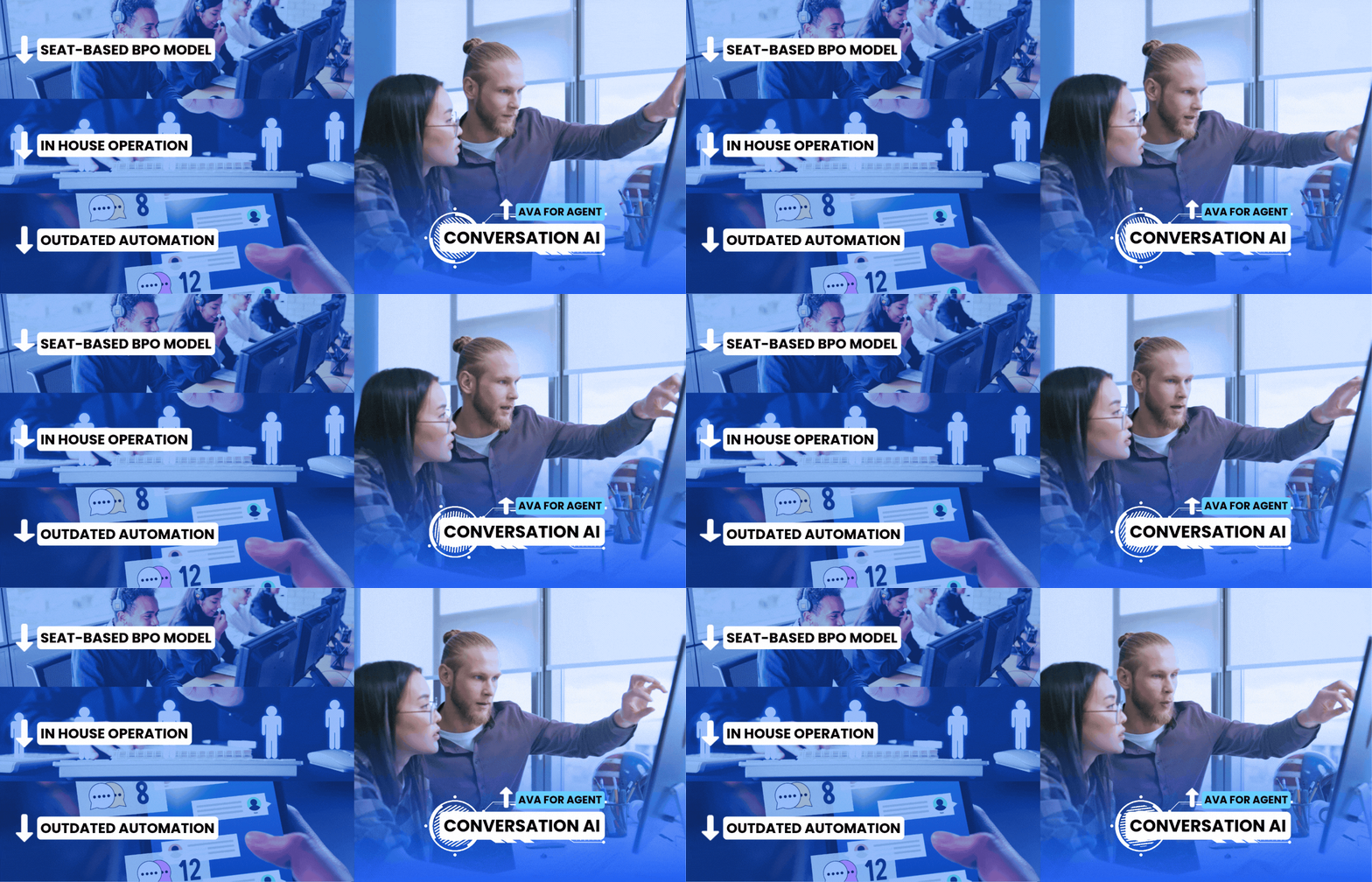
As the landscape shifts, a new distinction is emerging within outsourcing itself. Traditional BPOs still operate largely on seat based models built around labor arbitrage. Even when AI is introduced, it is often layered onto older systems, with growth and revenue still closely tied to headcount.
In contrast, modern AI integrated BPOs are built differently from the ground up. Technology is embedded across both the customer journey and the agent journey. Conversational AI manages interactions intelligently, real time agent assist strengthens performance, AI driven hiring accelerates talent acquisition, and advanced analytics turn conversations into insight.
Today, the convergence of aggressive wage hikes, mandatory workweek reductions, social security increases, and workforce volatility is creating a structural shift in global CX operations. This is not cyclical inflation. It is a permanent recalibration of cost structures across key markets such as Colombia, Mexico, Peru, Chile, and Argentina.
The question is no longer whether your customer support model works today. The real question is whether it can survive what is coming next.
Rising Labor Costs in 2026: Why Cost Per Contact Is Increasing
This year, rising labor costs will no longer be a gradual increase that businesses can absorb quietly. In countries like Colombia, Mexico, Peru, Chile, and Argentina, wage hikes, reduced workweeks, and expanded compliance requirements are significantly increasing the real cost of employing frontline agents.
In Colombia, a sharp wage increase combined with a shorter 42 hour workweek is pushing operational costs up by nearly 46 percent. Peru is seeing a 10% minimum wage increase due to mandatory additional salary structures and benefits. Mexico faces labor costs rising to 157.4 points in late 2025, indicating increased costs compared to prior years. Chile’s transition to a 40 hour workweek adds another 32 percent burden. Argentina’s volatility has reported a 38% year-over-year increase in the wage index by December 2025.
Whether support is outsourced or managed internally, these increases directly impact cost per contact. If you run operations in house, you absorb every regulatory and wage change into your profit and loss (P&L). If you work with a traditional BPO, those rising costs are passed on to you through higher rates. In both cases, you pay more without necessarily delivering better customer experience. The economics of support are structurally shifting, and the impact is unavoidable.
The Traditional, Seat-Based BPO Model: Why Headcount Driven Outsourcing No Longer Works
For decades, the traditional BPO model has been built around seats. Clients pay for the number of agents deployed. The more volume, the more seats. The more seats, the higher the billing. On the surface, this feels straightforward and predictable. However, this structure ties revenue to headcount rather than performance.
When contracts are based on seats, there is limited incentive to aggressively reduce handle time or automate intelligently, because efficiency can reduce billable capacity. At the same time, labor inflation is squeezing BPO margins, which often leads to rate increases passed directly to clients. Instead of paying for outcomes, many organizations end up paying for capacity and inefficiency.
Automation within legacy models can also fall short. Static IVR systems and rigid bots often frustrate customers, pushing them back to human agents. This increases interaction costs rather than lowering them. As wages rise and customers expect smarter digital experiences, a headcount driven outsourcing model becomes harder to sustain. Scaling through people alone is becoming financially fragile.
The In House Operational Trap: Payroll Exposure, Slow Hiring, and High Attrition
Running support internally provides control, but it also concentrates risk. As the Employer of Record, the organization is fully responsible for salaries, social security contributions, benefits, and compliance with changing labor laws. Every wage hike and regulatory update directly impacts operating expenses.
Beyond payroll exposure, many internal operations struggle with long hiring cycles. It can take more than a month to fill a single role, during which empty seats still generate overhead costs. HR teams manually screen thousands of resumes, invest thousands of dollars per hire, and then face attrition rates that often exceed 40 percent. As agents leave, the cycle repeats. Recruitment, onboarding, nesting, and ramp up become constant processes rather than occasional needs.
This creates operational strain and financial leakage. Adding to these costs is quality oversight., Most in-house quality teams review only a small percentage of interactions, leaving major blind spots in compliance, fraud detection, and customer sentiment analysis. The organization pays more each year while struggling to gain full visibility into performance.
Together, rising payroll costs, slow hiring, persistent attrition, and gaps in quality form a structural challenge. Without a shift toward smarter automation and intelligence driven support models, the traditional in house approach becomes increasingly difficult to sustain.
Customer Experience Automation in 2026: From Static Bots to Conversational AI
Automation is not the problem. Outdated automation is. Press one IVRs and rigid chatbots were designed to deflect volume, not to resolve issues intelligently. Modern customers expect conversational AI that understands intent, context, and sentiment.
This is where UnifyCX introduces Ava for Agents. Ava is not a static bot. It is conversational AI designed to handle real interactions. It can resolve routine inquiries autonomously while recognizing when human intervention is required.
When escalation occurs, Ava for Agents provides real time assistance to the human representative. Agents receive live guidance, contextual knowledge, compliance prompts, and next best action recommendations.
This reduces average handle time, improves first contact resolution, and increases agent confidence. Instead of replacing humans, the system amplifies their effectiveness. The result is lower cost per contact through intelligence, not through workforce reduction alone.
AI Driven Recruitment and Training: Instascreen and Study Buddy
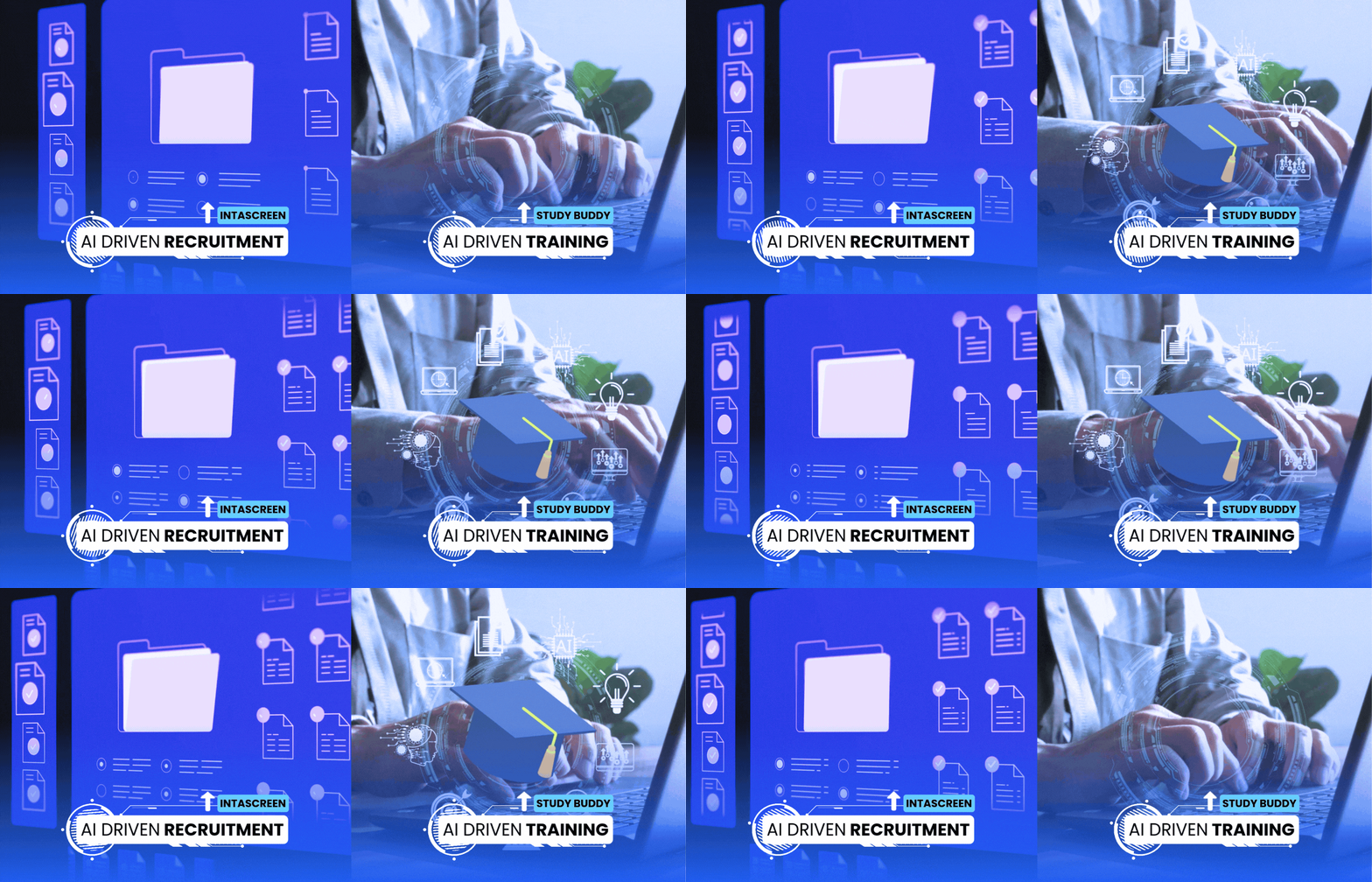
To address the recruiting factory problem, UnifyCX deploys Instascreen powered by Matchpoint technology. Instead of a 44 day hiring cycle, thousands of resumes can be screened in minutes. The system identifies top fit candidates based on skills, behavioral indicators, and performance predictors. Hiring decisions that once took weeks can occur within 24 hours. This dramatically reduces HR overhead and shortens time to productivity.
Training is equally critical. Our Study Buddy leverages AI driven onboarding to accelerate learning curves. New agents reach proficiency faster, reducing nesting time and stabilizing retention from day one. Organizations stop paying for perpetual ramp up. They begin paying for performance and consistency.

100% Quality Assurance and Voice of Customer Intelligence
One of the most transformative shifts lies in quality and insight. UnifyCX eliminates the 1% audit limitation by implementing 100% QA coverage. Every interaction across voice, chat, and digital channels is analyzed.
Voice of Customer analytics converts support conversations into structured intelligence. Instead of receiving a monthly PowerPoint with average CSAT, leadership gains real time dashboards identifying more than 3,700 unique churn drivers, emerging sentiment patterns, compliance risks, and competitive signals.
Support transitions from being a cost center to becoming a strategic intelligence asset for the C-suite. This is not incremental reporting improvement. It is operational visibility at scale.
Lead the Shift Before the Market Forces It
Customer support is no longer just an operational function. It is a marginal decision. Structural wage inflation and compliance burdens are making headcount-only scaling economically untenable. Against this backdrop, the strategic imperative is not whether to adopt AI, but how quickly it can be deployed to protect EBITDA, stabilize cost per contact, and unlock measurable ROI.
Leaders who adopt AI decisively will reduce cost per contact, protect margins against labor inflation, and transform customer support from a rising expense into a measurable financial asset. Those who delay risk absorbing volatile payroll costs while competitors build scalable, intelligence-driven advantages.
Transforming Support from an Expense to an Asset
The 2026 labor market has reached a tipping point where scaling via headcount is no longer a growth strategy; it’s a financial liability. With mandatory wage hikes and workweek reductions across key markets, traditional “seat-based” models are causing a permanent spike in cost-per-contact that erodes margins. To remain competitive, leaders must shift from buying human capacity to investing in an intelligence ecosystem that decouples operational growth from rising payroll.
Choosing UnifyCX as a partner allows you to move beyond this “operational trap” by fusing human talent with conversational AI and 100% QA visibility. Instead of absorbing the costs of attrition and slow hiring, you gain a scalable model that converts support interactions into strategic data assets. This transition isn’t just about efficiency; it’s about future-proofing your EBITDA against a volatile global economy and turning a rising expense into a measurable competitive advantage.