

 To understand why rapid support matters so much, you have to understand how user behavior has changed.
The streaming journey doesn’t begin with content; it begins with intent. A recommendation pops up, a friend suggests a show, or an algorithm nudges something into your feed. Within seconds, a user decides to watch. And once that decision is made, expectations are already set: everything should work instantly, including support if something goes wrong.
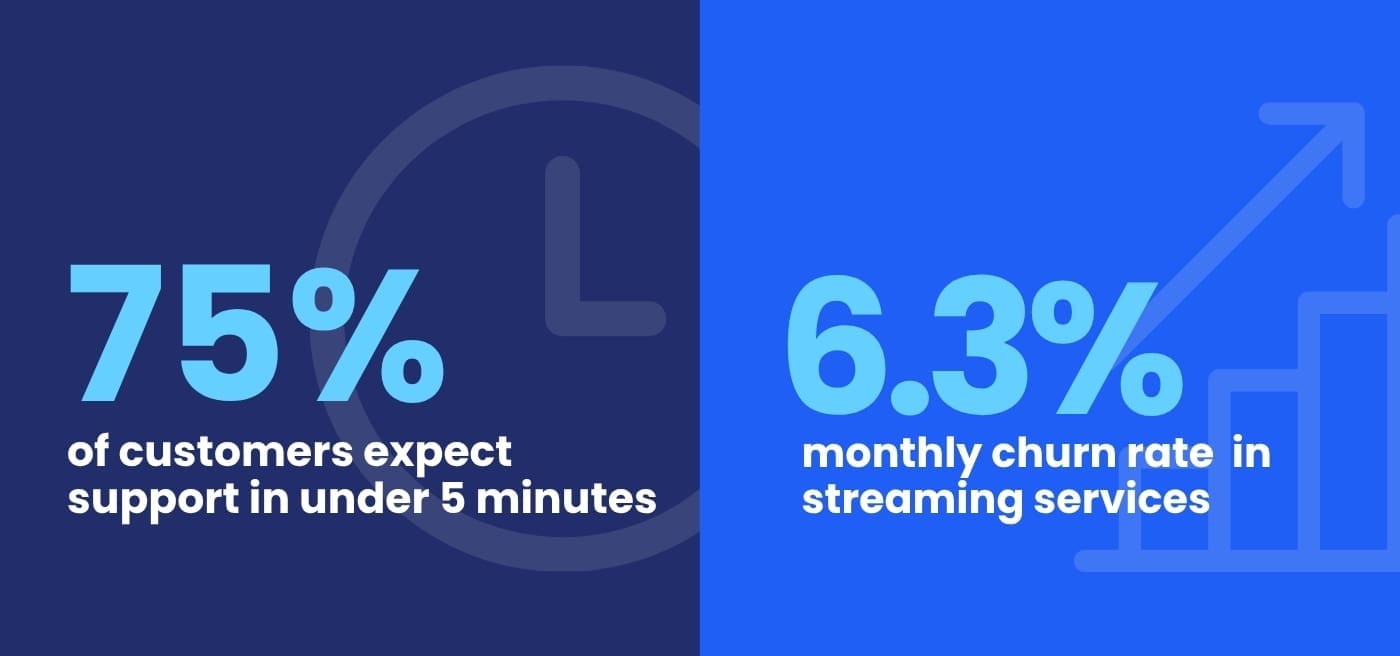
But today’s users are not just digital-first, they are instant-first. They don’t tolerate delays because they’ve been conditioned not to. Every app they use, from ride-hailing to payments to e-commerce, delivers near-instant responses. Today, 75% of customers expect help within five minutes when they reach out for support, and delays beyond that significantly impact satisfaction (HubSpot).
When a customer already feels overwhelmed by subscriptions, a billing issue, cancellation problem, login failure, or unresolved support ticket becomes the final trigger to leave — even if they still like the content. What’s important to understand here is perception. Users may encounter different types of issues, but they don’t separate the problem from the response. To them, the experience includes how quickly and easily it gets resolved. If support is slow, unavailable, or disconnected, the entire brand feels unreliable.
Right now, entertainment streaming services average a 6.3% monthly churn rate, equal to more than 54% annually (RetentionCheck). Streaming providers already operate in an environment with high churn, low loyalty, subscription fatigue, binge-and-cancel behavior, and rising acquisition costs. That means every support interaction becomes disproportionately important.
At the same time, loyalty has fundamentally changed. It’s no longer built over years; it’s earned in moments. 65% of users say the quality of customer experience directly influences their decision to renew subscriptions (Gitnux). And when that experience falls short, switching is effortless. In fact, 42% of consumers are more likely to keep bundled streaming services, reinforcing how perceived value and customer experience directly influence subscriber loyalty (Hub Entertainment Research).
This creates a new, competitive landscape. You are no longer just competing on content or features. You are competing on how quickly and effectively you show up when your users need help the most.
 Streaming platforms are operating in an environment where customer patience is shrinking faster than ever. Users are no longer comparing your support experience to another streaming brand. They are comparing it to every instant digital experience they have across ride-hailing, e-commerce, banking, and social media.
And that changes the role of customer support entirely.
Support can no longer function as a reactive, ticket-resolution operation that steps in after frustration has already peaked. In streaming, where engagement happens in real time, the ability to resolve issues instantly has a direct impact on retention, loyalty, and recurring revenue.
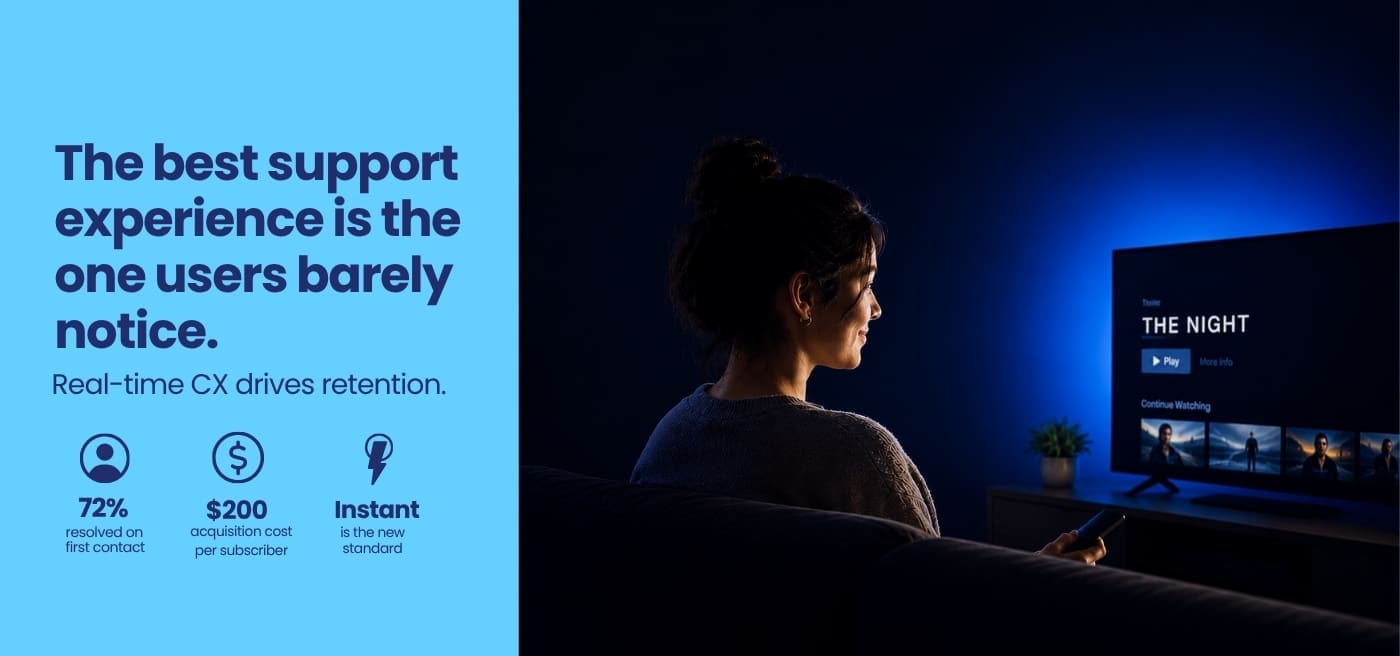
The financial impact is massive. When it can cost up to $200 to acquire a single subscriber and up to 15 months of subscription revenue just to recover acquisition costs, every unresolved billing issue, failed login experience, or frustrating support interaction becomes exponentially more expensive (Deloitte).
That’s why streaming platforms need to move beyond fragmented support models and rethink CX as a real-time retention strategy.
This starts with reducing effort across the entire support journey. Users should not have to dig through help articles, repeat issues across channels, or wait endlessly for escalation. They expect support to feel immediate, connected, and context-aware from the very first interaction.
It also means shifting from reactive service to proactive engagement. Instead of waiting for users to report problems, platforms need the ability to identify friction early, surface relevant support instantly, and resolve issues before frustration turns into churn.
Small operational improvements can create significant business impacts at scale. Research shows that 72% of support issues across industries are resolved on first contact, making first contact resolution (FCR) one of the strongest indicators of customer satisfaction and operational efficiency (Converge). For streaming platforms handling millions of support interactions related to password resets, subscription management, device authentication, and billing issues, those efficiency gains compound rapidly.
The streaming platforms that win over the next few years will not simply be the ones with the biggest content libraries. They will be the ones that make support feel invisible, effortless, and immediate when users need it most.
In streaming, customer experience is measured in moments. A delayed response, disconnected interaction, or unresolved issue can quickly turn engagement into churn. That’s why streaming platforms need more than support tools. They need a connected CX ecosystem designed to reduce effort and resolve issues fast.
UnifyCX combines CX strategy, omnichannel support, CX & EX analytics, and AI-powered operational capabilities to help streaming platforms deliver seamless support experiences at scale.
CX Strategy & Journey Design That Reduces Friction
The streaming experience is designed for effortless signup, but when something goes wrong, customers are pushed into a frustrating cycle of bots, dead ends, and repeated explanations. The ideal customer journey for a streaming service provider is seamless, fast, personalized, and effortless from beginning to end. Customers should be able to sign up easily, stream without interruption, resolve billing or technical issues quickly, and receive consistent support across every channel, whether through chat, voice, email, social, or self-service. When problems arise, support should feel proactive, connected, and human, with minimal wait times and no need for customers to repeat themselves.
UnifyCX helps deliver that experience by designing intelligent customer journeys that effectively connect skilled support teams, omnichannel engagement, AI-powered assistance, workflow optimization, and customer insights to reduce friction at every touchpoint. By improving response times, increasing first-contact resolution, and creating more personalized interactions, UnifyCX helps streaming brands strengthen loyalty, reduce churn, and turn customer support into a competitive advantage.
AI-Enhanced Omnichannel Support That Meets Customers Where They Are
Today’s streaming customers expect support to be as fast and intuitive as the platforms they use every day. They want the freedom to move between channels without losing context, receive answers in real time, and resolve issues without navigating disconnected systems or starting over with every interaction. Whether reaching out through chat, voice, email, SMS, social media, or self-service, customers expect support experiences that are responsive, personalized, and always available.
UnifyCX helps streaming providers deliver connected, AI-enhanced omnichannel support experiences that combine automation with human expertise. Through intelligent routing, AI-powered agent assistance, conversational insights, and unified customer engagement, UnifyCX enables faster resolutions, more efficient interactions, and greater consistency across every channel. The result is a more scalable support operation that improves customer satisfaction, reduces operational strain, and creates stronger subscriber relationships in an increasingly competitive streaming landscape.
Intelligent AI, Automation & Voice of the Customer Intelligence at Scale
Streaming platforms operate in a high-velocity environment where support demand can spike without warning during outages, live events, billing cycles, or new content releases. At the same time, customers expect instant resolution, consistent service, and zero friction across every interaction. Meeting that expectation requires more than traditional support models; it requires intelligent automation, real-time insight, and continuous understanding of the customer voice.
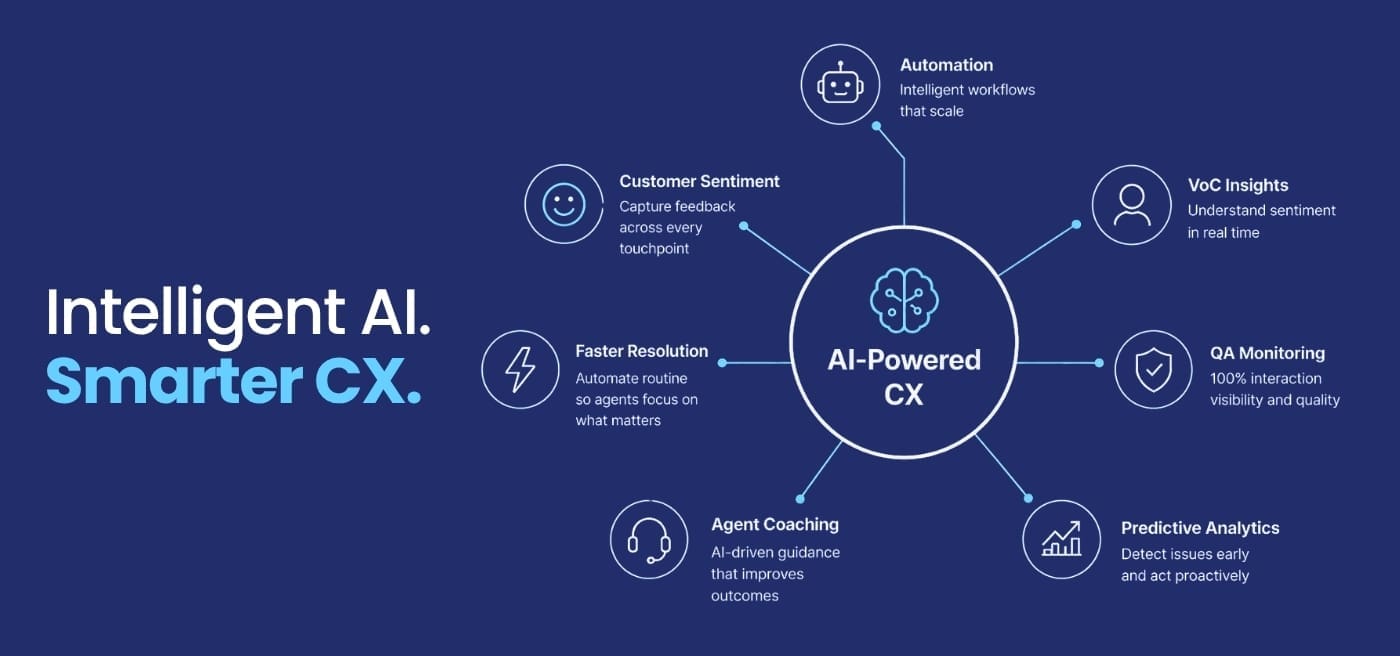
UnifyCX combines AI, automation, and Voice of the Customer intelligence to help streaming providers operate at this level of responsiveness. Through robotic process automation (RPA), intelligent workflows, and AI-powered summaries, UnifyCX accelerates resolution of high-volume, repetitive requests such as subscription changes, payment support, authentication issues, and account recovery. This reduces operational bottlenecks, shortens handle times, and enables agents to focus on complex, high-empathy interactions that drive retention.
Equally important, UnifyCX captures and activates customer sentiment through its Voice of the Customer (VoC) capabilities. By analyzing feedback across interactions, channels, and touchpoints, UnifyCX helps streaming providers understand not just what customers are saying, but what they are experiencing. These insights are continuously fed into the support ecosystem, informing coaching, improving workflows, and highlighting friction points before they scale into churn drivers.
Layered on top of this is AI-driven Quality Assurance and predictive CX analytics, which evaluate 100% of customer interactions to ensure consistency, compliance, and service quality. These same intelligence models also deliver personalized coaching recommendations to agents, improving resolution quality over time. Meanwhile, predictive signals such as repeated contacts, unresolved issues, declining engagement, or negative sentiment enable proactive intervention before customers disengage.
Together, these capabilities turn customer support from a reactive function into a continuously learning, insight-driven system that reduces churn risk, improves efficiency, and strengthens streaming subscriber loyalty.